
The first demonstration for the rights of Finnish sexual minorities was organised in Helsinki on 27 July 1974. The demonstration was spurred on by Seppo Kivistö’s firing. Following the publication of a magazine article, Kivistö was fired from his position as leading youth worker at Helsinki’s Old Church, where he was responsible for organising activities for boys. Kivistö had written a piece on homosexuality and about the position of gay people in society under the pseudonym “Stefan”. After his true identity was revealed, he was fired from his position. Kivistö later went on to work as SETA’s social secretary. The demonstration, which was organised in the Old Church Park in Helsinki, was attended by a few dozen people. The demonstrators did not attempt to conceal their faces or identities, carrying signs with different slogans. The event attracted enormous media attention, and it was widely discussed in the newspapers during the following months.
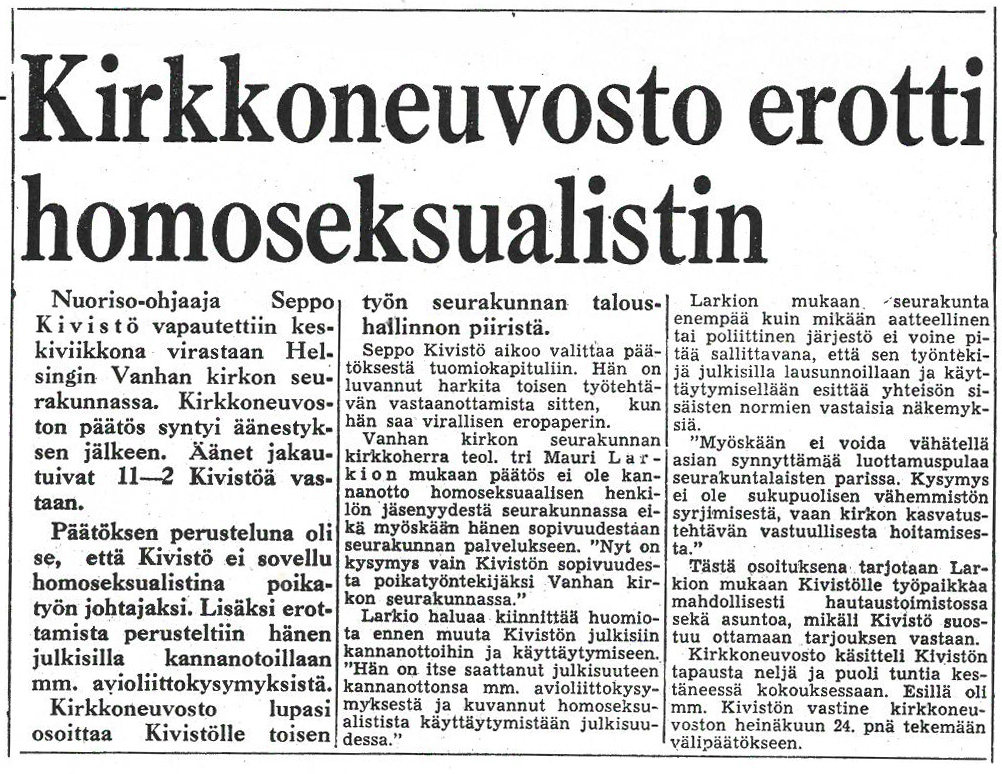
Helsingin Sanomat Sept. 5th 1974.
Church Council fires homosexualist
Youth counsellor Seppo Kivistö was relieved of his duties at the Old Church parish in Helsinki on Wednesday. The Church Council voted on the decision. The votes were divided 11 to 2 against Kivistö.
The Council argued that as a homosexualist, Kivistö was not fit to organise church activities for boys. It also named his public statements regarding issues such as marriage as a reason for his dismissal.
The Council stated it would offer Kivistö a job in the parish’s financial administration.
Seppo Kivistö says that he intends to appeal the matter to the cathedral chapter. He also stated that he will consider taking on the financial administration job offered once he has received a formal notice of dismissal from his employer.
Dr. theol. Mauri Larkio, minister of the Old Church parish, says that the Council’s decision is not to be seen as a statement on whether or not homosexual people can be members of the church or work within the church. “This decision concerns only the suitability of Kivistö as an employee responsible for boys’ activities at the Old Church parish.”
Above all, Larkio wishes to highlight Kivistö’s public statements and behaviour. “He has himself publicised his views on issues such as marriage and described his homosexualist behaviour in public.”
Larkio says that as any other ideological or political organisation, the church cannot accept employees’ public expressions of views that directly contradict the norms of the community, or tolerate behaviour that goes against these norms.
“In addition, one cannot overstate how deeply the parishioners’ trust has been broken by the things that have come to light. We are not discriminating against a sex minority, but rather ensuring that the church can take care of its pedagogical mission in a responsible way.”
Larkio says that as a token of its good faith, the church will possibly offer Kivistö a job in a funeral home along with housing if he is willing to accept it.
The Church Council discussed the Kivistö issue in a meeting that lasted four and a half hours. During the meeting, the members were presented with Kivistö’s response to the interim decision made by the Church Council on 24 July.